
Industry Insights / Management Companies, Brands & Ownership Groups
The Portfolio Advantage Is Connected Context at Scale
Portfolio advantage emerges when distinctive property truth, customer decisions, local expertise, operations, governance, analytics, and learning remain connected across responsible scale.
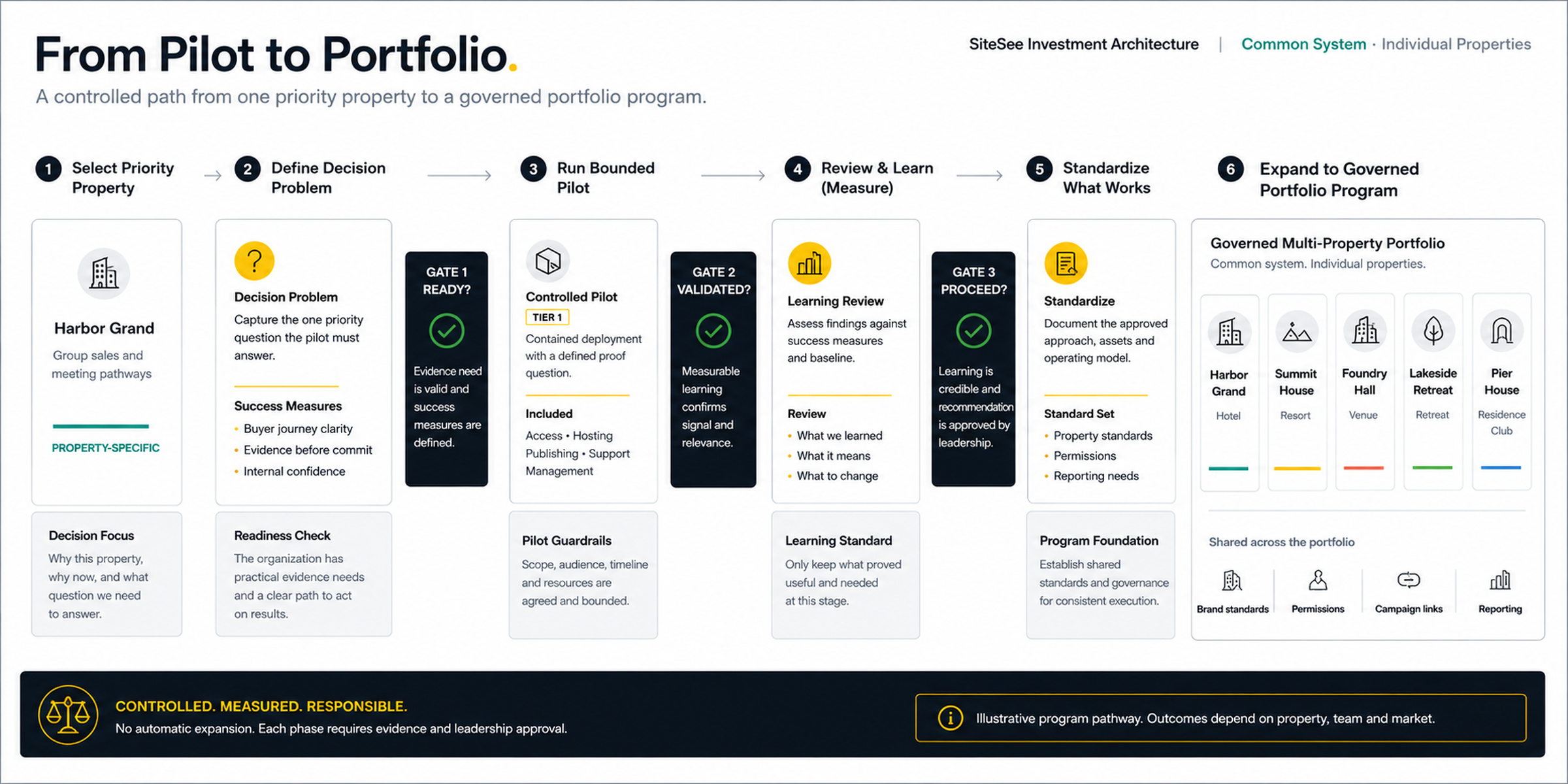
Scale becomes an advantage only through connection
A portfolio can contain remarkable properties while customers, sellers, operators, owners, and leaders still encounter fragmented understanding. Scale multiplies value when evidence, relationships, decisions, operations, and learning connect without erasing essential local differences. The advantage comes from usable context traveling farther, faster, and more responsibly across the organization.
Global portfolios illustrate the coordination challenge
Hilton reported 9,260 properties across 144 countries and territories at the end of March 2026. Marriott reported 9,805 properties across 145 countries and territories at year-end 2025 within its annual filing. These public-company disclosures illustrate scale but cannot represent every portfolio structure, contract, property type, or operating reality.
Connected context is more than centralized content
A centralized library may still contain duplicate files, unclear ownership, outdated claims, incompatible definitions, and missing relationships. Context connects evidence with source, purpose, audience, place, time, permissions, decisions, operations, outcomes, and responsible authority. Central storage becomes portfolio intelligence only when people can determine what information means and where it applies.
Local truth remains the foundation
Architecture, market, culture, ownership, services, staff, climate, regulation, history, and community relationships make every property distinctive. Portfolios should establish shared evidence standards while allowing fields, workflows, explanations, and experiences responsive to local reality. Advantage disappears when consistency becomes sameness and customers lose the distinctions needed for responsible choice.
Customer journeys should cross properties intelligently
Customers may compare several properties, audiences, dates, experiences, spaces, services, routes, prices, risks, and accessibility considerations. Connected context preserves questions and priorities while revealing genuinely comparable evidence and meaningful local differences. Portfolio guidance becomes helpful when it improves choice rather than simply promoting whichever property has available inventory.
Human sellers should inherit broader understanding
Central, regional, brand, property, reservations, group, and specialist teams may contribute to one commercial relationship. They need permissioned customer context, current property evidence, previous answers, alternatives, commitments, and responsible next actions. Sellers create greater value when the platform reduces searching while preserving their judgment, expertise, and relationships.
Operations should receive the commercial promise
Reservations, events, guest services, facilities, housekeeping, culinary, security, accessibility, and partners deliver what customers understood earlier. Connected context should carry relevant promises, assumptions, changes, requests, exceptions, responsibilities, and source evidence into execution. Operational confidence grows when teams can trace expectations instead of discovering commitments through last-minute customer questions.
Governance should distribute authority clearly
Enterprise teams can define infrastructure, standards, security, shared services, analytics, support, investment, and minimum controls. Local teams can verify conditions, interpret audiences, maintain relationships, identify change, and preserve distinctive knowledge. Decision rights should explain who creates, reviews, approves, publishes, corrects, measures, and retires each information category.
Data assets need sustained usefulness
ISO 55013:2024 offers guidance for managing data assets supporting organizational and asset-management objectives throughout their lifecycle. It does not prescribe portfolio commerce, property models, customer experience, platform architecture, governance design, or financial returns. Organizations still need explicit users, purposes, definitions, quality criteria, context, controls, ownership, measures, and improvement responsibilities.
Security must support connection responsibly
Portfolio context can include personal information, commercial agreements, operations, restricted spaces, suppliers, identities, and sensitive decisions. NIST Cybersecurity Framework 2.0 provides outcome-focused risk guidance without certifying implementations or guaranteeing complete protection. Organizations need proportionate governance across assets, access, suppliers, monitoring, response, recovery, leadership oversight, and applicable obligations.
Accessibility should improve across the whole system
Customers and employees encounter digital content, buildings, services, communication, transportation, events, reservations, and support across portfolios. Web standards strengthen accessible information but cannot certify physical compliance or every individual's complete property experience. Portfolios should connect applicable requirements, qualified expertise, disabled perspectives, evidence, testing, accommodations, corrections, and accountable action.
Changes should propagate with context
Renovations, closures, services, policies, ownership, branding, rates, weather, and operating conditions can alter customer decisions. Change management should identify affected properties, audiences, channels, reservations, proposals, partners, operations, dependencies, notifications, and alternatives. Updates become trustworthy when effective timing and decision impact remain as visible as the revised content.
Corrections should improve the entire portfolio
An outdated image, unclear category, wrong capacity, missing restriction, or inaccessible route may reveal systemic weakness. Teams should correct immediate records while examining sources, processes, training, technology, affected properties, and recurrence risks. Local errors become portfolio learning when corrective action strengthens foundations beyond the original property or channel.
Analytics should reveal where decisions struggle
Questions, response time, content use, revisions, drop-offs, changes, recovery, adoption, and operational reuse can reveal friction. Measures require consent, privacy, definitions, baselines, segments, local context, qualitative evidence, bias review, limitations, and accountable ownership. Portfolio comparisons should prompt investigation rather than rank properties automatically without understanding different audiences and operating conditions.
Investment should follow validated opportunity
Leaders can connect funding with customer difficulty, employee effort, operational risk, content gaps, change volume, and reusable improvement. Business cases need baselines, assumptions, costs, benefits, adoption, owners, timelines, limitations, and validation appropriate to each decision. Portfolio advantage grows through disciplined reinvestment rather than technology expansion disconnected from measurable operating needs.
Innovation should move without losing evidence
One property may develop better capture, accessibility, selling, event planning, service recovery, or operational communication practices. Reuse should preserve the original problem, context, intervention, users, resources, outcomes, limitations, and validation approach. Portfolios can adapt promising work confidently without copying visible outputs that depended upon unrecorded local conditions.
Standalone VR can contribute important spatial evidence
Conventional virtual reality can communicate presence, appearance, scale, adjacency, atmosphere, imagery, learning, and possible visit intentions under suitable conditions. Hospitality and tourism research has reported positive effects within particular participants, technologies, properties, measures, and experimental designs. Those findings do not establish portfolio governance, accessibility, operational integration, conversion, satisfaction, trust, security, or financial returns.
Immersion alone cannot create portfolio advantage
A collection of virtual tours may display properties while leaving audiences, teams, workflows, changes, and outcomes disconnected. Standalone VR does not inherently coordinate permissions, selling, distribution, reservations, operations, recovery, analytics, governance, or organizational learning. Portfolio advantage requires broader infrastructure joining spatial understanding with accountable people, evidence, systems, decisions, and delivery.
SiteSee creates connected context at scale
SiteSee places immersive property understanding inside a proprietary platform supporting governance, collaboration, analytics, distribution, and operational continuity. Teams can connect properties, audiences, evidence, sellers, channels, permissions, operations, changes, recovery, feedback, actions, and outcomes. This structure provides substantially stronger organizational capability than standalone VR without comparable feature-rich tools and operating infrastructure.
Connected context compounds through use
Every question, decision, correction, implementation, and outcome can improve property evidence and future organizational guidance. Our earlier portfolio learning perspective explained why each property should strengthen subsequent decisions without surrendering local identity. Compounding requires visible action, validation, governance, and practical value returning to the teams contributing knowledge.
Advantage appears in better decisions
Customers understand properties faster, sellers guide choices better, operators receive clearer expectations, and leaders see accountable learning. Properties retain their distinctive character while shared infrastructure reduces duplication, contradiction, delay, risk, and preventable decision friction. The portfolio advantage is connected context at scale because understanding becomes stronger wherever responsible decisions occur.
Sources and evidence
- Hilton Worldwide Holdings, First Quarter 2026 Form 10-Q (opens in a new tab), filed April 2026.
- Marriott International, 2025 Form 10-K (opens in a new tab), filed February 2026.
- International Organization for Standardization, ISO 55013:2024 Guidance on Managing Data Assets (opens in a new tab), July 2024.
- National Institute of Standards and Technology, Cybersecurity Framework 2.0 (opens in a new tab), February 2024.
- World Wide Web Consortium, Web Content Accessibility Guidelines 2.2 (opens in a new tab), December 2024.
- McLean and Barhorst, Living the Experience Before You Go (opens in a new tab), Journal of Travel Research, 2022.
- Tussyadiah and colleagues, Virtual Reality, Presence, and Attitude Change (opens in a new tab), Tourism Management, 2018.
Prepared and reviewed August 14, 2026.